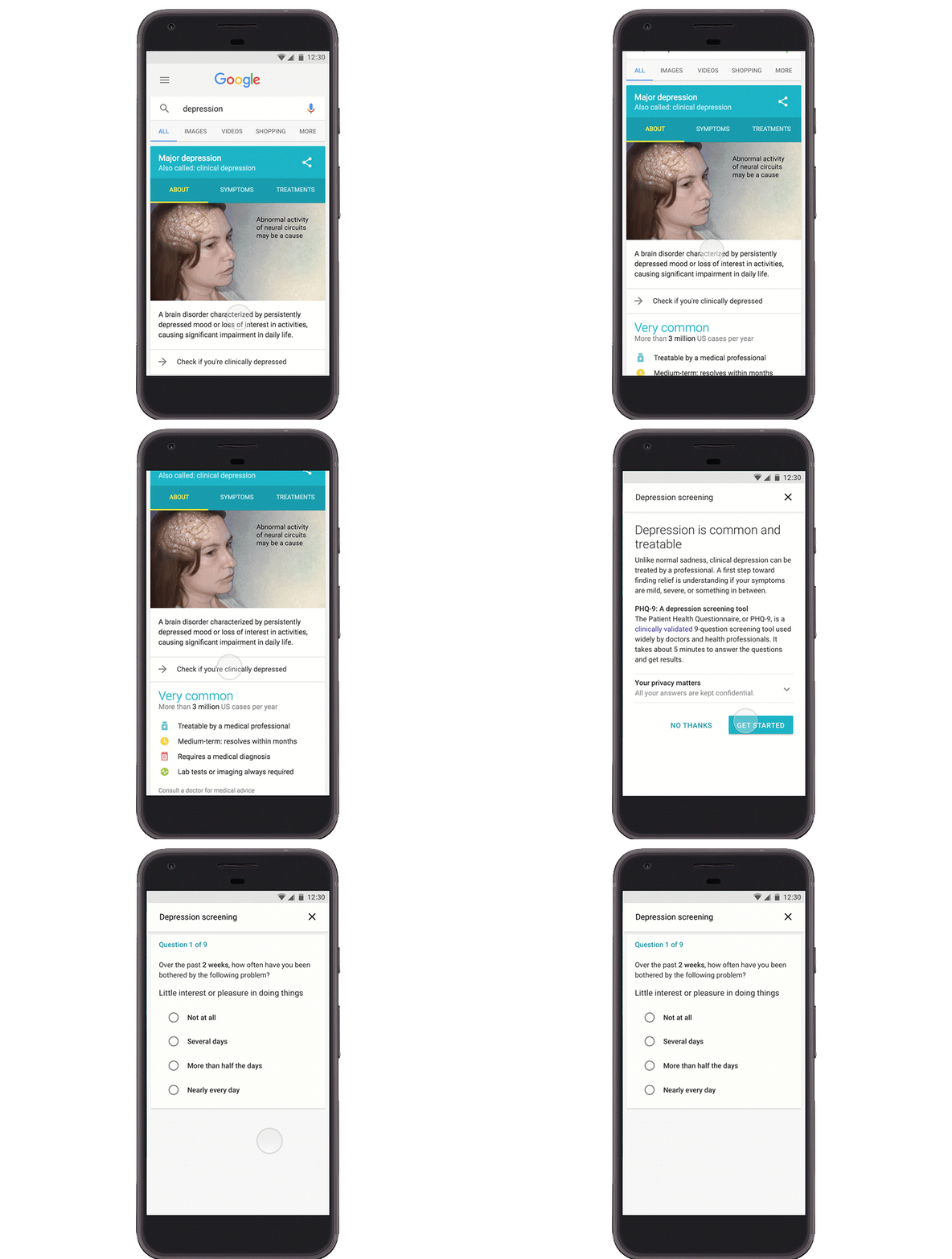
Google Connects Mobile Searchers to Depression Assessment Tool

The National Alliance on Mental Illness on Wednesday announced that Google on mobile now provides people who search for the term "clinical depression" with a direct link to the PHQ-9 questionnaire used by medical professionals in the United States to evaluate patients for the disorder.
People can conduct a self-assessment by filling in the questionnaire online.
When someone conducts a Google search on mobile for information on "clinical depression," a link to "check if you're clinically depressed" will appear in the depression knowledge panel.

Clicking on the link will take the user to the PHQ-9 questionnaire.

NAMI hopes teaming up with Google will help raise awareness of clinical depression and lead sufferers to determine their level of depression and the need to seek help, said Mary Giliberti, the organization's CEO.
Clinical depression is a treatable condition, and the PHQ-9 can be the first step to getting a proper diagnosis, she noted.

Noble Effort

One in five Americans experience an episode of clinical depression in their lifetime, but only about half the sufferers receive treatment, Giliberti pointed out, and generally only after six to eight years.
"By making PHQ-9 easily accessible in the Clinical Depression Knowledge Panel, we hope that will help provide useful and insightful information to spur deeper research on the Web or to help you have more in-depth conversations with your doctor," said Google spokesperson Susan Cadrecha.
"The effort is noble, though I'd feel better if this project was managed by someone other than Google, with the appropriate medical background, oversight and protections, such as a major hospital," remarked Rob Enderle, principal analyst at the Enderle Group.

Privacy Questions

Because Google stores user data, there may be legitimate concerns that information entered into the PHQ-9 form would be retained. 
"The privacy and security of our users is of the utmost importance," Google's Cadrecha told TechNewsWorld.
"We recognize that this information is sensitive and private, and Google will not store your responses or your results," she said.
"This speaks to trust, and whether management actually knows what the engineers who have set this up actually did," Enderle told TechNewsWorld.
"In the past, Google has been lax with regard to oversight," he added, so concerns about data retention are reasonable, "even though it clearly isn't an executive intent."
Google parent Alphabet already collects some data on consumers' health.
Its Verily Life Sciences division, formerly Google Life Sciences, in 2014 launched Project Baseline, which seeks to collect phenotypic health data from about 10,000 participants over four years.
The project will make de-identified data from the study available to qualified researchers for exploratory analysis.

Google Is Watching You?

"Google sees everything that moves through their portal," said Michael Jude, a research manager at Stratecast/Frost & Sullivan.
"At some level, everything's stored for some period of time," he told TechNewsWorld.

Google is "asking us to trust them not to store anything long term," Jude added. "However, the act of seeing this data lets it build profiles of users."
The company "probably already can build a psychological profile of its users from their searches and other user data," he speculated. "If a profile leaked, they could claim that it was simply from publicly disclosed data. How could anyone prove otherwise?" 


source: http://www.technewsworld.com

Tensor Flow Serving 1.0

We've come a long way since our initial open source release in February 2016 of TensorFlow Serving, a high performance serving system for machine learned models, designed for production environments. Today, we are happy to announce the release of TensorFlow Serving 1.0. Version 1.0 is built from TensorFlow head, and our future versions will be minor-version aligned with TensorFlow releases.


For a good overview of the system, watch Noah Fiedel's talk given at Google I/O 2017.

When we first announced the project, it was a set of libraries providing the core functionality to manage a model's lifecycle and serve inference requests. We later introduced a gRPC Model Server binary with a Predict API and an example of how to deploy it on Kubernetes. Since then, we've worked hard to expand its functionality to fit different use cases and to stabilize the API to meet the needs of users. Today there are over 800 projects within Google using TensorFlow Serving in production. We've battle tested the server and the API and have converged on a stable, robust, high-performance implementation.


We've listened to the open source community and are excited to offer a prebuilt binary available through apt-get install. Now, to get started using TensorFlow Serving, you can simply install and run without needing to spend time compiling. As always, a Docker container can still be used to install the server binary on non-Linux systems.


With this release, TensorFlow Serving is also officially deprecating and stopping support for the legacy SessionBundle model format. SavedModel, TensorFlow's model format introduced as part of TensorFlow 1.0 is now the officially supported format.
To get started, please check out the documentation for the project and our tutorial. Enjoy TensorFlow Serving 1.0!

source: Kiril Gorovoy, Software Engineer

Google launches Security features while report shows iOS threats outpacing Android

Google has cracked down on security with the launch of Play Protect and other new defense mechanisms while a report has been released which shows iOS malware growth outpacing that of Android.

After the Google Docs phishing attack, the company has been ramping up its security in recent months. This started back in May with the implementation of machine learning to improve the detection of phishing messages – and the company now estimates it can block spam and malicious content with a 99.9 percent accuracy.
The following month, in June, Google added security controls to G Suite which enables admins to block employees from accessing untrustworthy apps. The phishing attack was caused by a bogus app using a Google sign-in, so this feature helps to ensure admins can vet third-party apps.
Earlier this week, Google added a new warning screen for apps from developers which are yet to go through verification. You can still choose to continue, at your own risk, but you’ll be prompted with a warning message and must type “continue” in the field to help ensure the user has read the prompt and hasn’t just clicked ‘ok’ to get rid of the message (against our better judgement, most of us have probably done it at some point!)

"We're committed to fostering a healthy ecosystem for both users and developers," wrote Google's Naveen Agarwal and Wesley Chun in a blog post. "These new notices will inform users automatically if they may be at risk, enabling them to make informed decisions to keep their information safe, and will make it easier to test and develop apps for developers."
Now the company is putting its focus on Android security with the roll-out of Play Protect to all devices running Google Play Services 11 and up. All of the apps downloaded from the Play Store will be scanned to detect anything malicious and will be removed or blocked on the device. Of course, if the user is side-loading apps outside the official store, they still run a higher risk of being hit by a form of malware.
Speaking of, as reported by our sister publication EnterpriseCIO, the growth of malware targeting iOS has tripled and now outpaces Android which remained largely flat over the past couple of quarters. The research was conducted by mobile security company Skycure.
Varun Kohli, Vice President of Marketing at Skycure, said, "iOS is used on one of the more popular devices and that is where hackers are focusing and that is where the money is. A more affluent community tends to use the iPhone."
iOS still has some way to go before it has the same level of risk as Android, but it’s good to see Google being more proactive about the security issue on its platform. Hopefully, the rapidly growing threat to iOS will ensure Apple doesn’t become complacent.
Do you think Google is doing enough in terms of security? Share your thoughts in the comments.

source: developer-tech.com

Google I/O Extended.

Google I/O is an annual software developer-focused conference held by Google in San Francisco, California. Google I/O features highly technical, in-depth sessions focused on building web, mobile, and enterprise applications with Google and open web technologies such as Android, Chrome, Chrome OS, Google APIs, Google Web Toolkit, App Engine, and more.

Google I/O was started in 2008. The "I" and "O" stand for input/output, and "Innovation in the Open". The format of the event is similar to that of the Google Developer Day.

Google AppEngine: My other computer

Google's Cloud Technologies has been among one of the leading technologies ever introduced on the internet. Google has given businesses, schools and individuals to store an extract huge sum of data from their data farms with just a click of a button, or a complexity that is not in itself a burden on users.

That notwithstanding, they have likewise created a platform for developers to use the same technologies that power Google to create awesome applications which run in the cloud. Whats more, you get to store all these data in the cloud and forget about management of the application on the server.

With App Engine and the Google Cloud Platform applications, you have a new computer either than your physical computer. Hundreds of developers have and are using the power of he cloud platform applications to build more scalable applications which gives their application the power to do what they are suppose to do and also remove server management burden from the developers. The nicest thing about this is that you are not exempted from it.

Google App Engine which is a free part of the cloud platform technologies is so easy to use even for a beginner who just started programming in Java, Python, Go or PHP. To get started make sure you have a gmail account and follow this document.

The Google Developer Community at the University of Cape Coast, UCC, wish to also invite you for an event which climaxes their series of events around Google App Engine this year. Register for the event here or here. Very soon a brand new blog post series will also be started on this very topic. Keep reading.

Ubuntu smartphone offers alternative to apps....

Ubuntu smartphone offers alternative to apps
By Leo Kelion
The handset's operating system connects different services to create theme-based cards

An Ubuntu-powered smartphone is coming to the market a year and a half after a previous attempt to launch a model via crowdfunding failed.
The Aquaris E4.5 Ubuntu edition relies on a card-like user interface that is not focused on apps.
Unlike the original proposal, the handset does not become a desktop PC when plugged into a monitor.
It is initially being targeted at "early adopters", who developers hope will become advocates for the platform.
The British company Canonical, which developed the Linux-based operating system, said it hoped to emulate the success of Chinese companies including Xiaomi with its launch strategy.
This crowdfunding campaign raised nearly $13m but still fell short of its target
This will include holding a number of "flash sales" in Europe beginning next week, in which the device will be sold for short periods of time - giving the developers an opportunity to gauge demand and respond to feedback before committing to a bigger production run.
"It's a proven model - we're making sure that the product lands in the right hands," Cristian Parrino, vice-president of mobile at Canonical, told the BBC.
"We are way away from sticking this in a retail shop in the High Street. [But] it's where we want to get to."
Millions of PCs used by schools, governments and businesses already run the desktop version of Ubuntu.
"The Ubuntu fan base will clamour to buy the phone just because they will be curious to see what it is, how it works and how they can develop for it - they'll want to be one of the few that have it," said Chris Green, from Davies Murphy Group Europe.
"But for the broader, more mainstream, early adopter market, I think demand will be constricted because people are more app-focused."
Scope cards
The Ubuntu handset can run apps written in either the HTML5 web programming language or its own native QML code.
However, its operating system effectively hides them away. Instead of the traditional smartphone user interface - featuring grids of apps - it uses themed cards that group together different facilities.
Canonical calls these Scopes, and they are reminiscent of the swipe-based card system used by the Google Now personal assistant.
Device owners can configure the Scopes to add the services they preferScopes
The phone's home screen is the Today Scope. It presents a selection of widgets based on the user's most frequent interactions on the phone.
These can include the local weather forecast, the headlines of the day from third-party news services, Twitter trends and a list of the owner's most commonly contacted friends.
By swiping to the right, the owner can make a call or access some of the other default Scopes, including:
  • A Music Scope, with favourite tracks sourced from Soundcloud and other streaming music providers, as well as offering details of forthcoming concerts via Songkick
  • A Video Scope, which presents clips from YouTube and other services
  • A Photos Scope, which collects together images stored on the phone as well as pictures stored on Flickr, Picasa, Facebook and elsewhere
  • A Nearby Scope providing location-specific details, including traffic conditions, public transport options and restaurant recommendations
  • An Apps Scope, which provides access to the camera, calendar software and programs from other companies
Users can create and configure their own Scopes, and individual services can also be set to have Scope cards of their own.
Third-party services can be set to have separate cards to themselves in the user interface
Mr Parrino suggested that the benefit to the user was an "unfragmented" experience, while developers would gain by being able to make their products available via Scopes at a fraction of the cost of creating full apps.
"If you come out with a new [OS] that's based on apps and icons then you're just a 'me too' platform," he said.
"You'll only be as relevant to developers as the number of users you can bring to them, because you're adding the burden of supporting a new platform. And for users you'll only be as good as the apps that you have.
"We've had to switch that model around and deliver an experience that is valuable in its own right - clearly the more services that plug into it the better it becomes, but it's not fully dependent on them from day one, and for an early adopter audience it's a great product."
Certain services will, however, be missing at launch, including Whatsapp, Skype and several of Instagram's core features.
'Stopgap' features
Canonical makes money by charging organisations for support services.
The phones themselves are being made and sold by a Spanish company, BQ, which already has an Android variant of the hardware.
They include an eight-megapixel rear camera, a 5MP front one and one gigabyte of RAM memory. They will cost about 170 euros ($195; £127).
"It's a good-looking device and a very slick interface at a realistic price," commented Mr Green.
"Scopes are an interesting stopgap between a full third-party app environment and a fixed feature phone.
"However, they are just that - a stopgap. They will interest very early adopters and the Ubuntu faithful in the short term. However, it won't take long before people start wanting a full add-on app experience akin to the other existing platforms on the market today."

Android adware 'infects millions' of phones and tablets.

Android adware 'infects millions' of phones and tablets
By Leo Kelion


Google has suspended access to Durak card game among other titles
Android users are being warned that several popular apps that were on the official Google Play store appear to have contained hidden code that made malicious ads pop up.

Security firm Avast said that one of the apps involved - a free version of the card game Durak - had been downloaded up to 10 million times, according to Google Play's own counter.

Google has now blocked access.

But one expert noted that the problem might be less widespread than feared.

Avast said that it first became aware of the issue after a member of the public contacted it after carrying out his own investigation into how his Nexus 5 smartphone had come to be infected with malicious code.

The "adware" was causing spurious pop-up messages to appear that had been made to look like system notifications. These told him his phone was running "slow" and that he needed to install new software to fix the problem.

If he followed the on-screen prompts he was then directed to download other apps, only some of which were legitimate.

"You get re-directed to harmful threats on fake pages, like dubious app stores and apps that attempt to send premium SMS behind your back or to apps that simply collect too much of your data for comfort while offering you no additional value," wrote Avast's malware analyst Filip Chytry.

The adware brought up a range of fake warning messages

The original apps were said to have held off showing the pop-ups until seven or more days after being installed, which the analyst suggested was intended to mask the fact that they were responsible.
"Most people won't be able to find the source of the problem and will face fake ads each time they unlock their device," he wrote.
"I believe that most people will trust that there is a problem that can be solved with one of the app's advertised 'solutions' and will follow the recommended steps, which may lead to an investment into unwanted apps from untrusted sources."
In addition to the Durak card game, other apps alleged to be involved include:
  • A Russian language IQ test, which Google Play indicates had been downloaded up to five million times
  • A Russian history educational tool, which Google Play indicates had been downloaded up to 50,000 times
A search by the BBC for other apps made by the same developers revealed dozens more apps, including video games, a psychology guide, wedding planning software and cookery tips - all of which have now been blocked.
Wedding planning app
A wedding planning app is among the apps that are currently blocked
The publishers involved have not replied to requests for comment.
A spokesman for Google said: "We're just confirming that all of the apps in the report have been suspended and nothing more."
Inflated numbers
Although Google Play's own site indicated the software had been downloaded many millions of times, one security researcher was cautious about the figures.
"I would take the numbers with a pinch of salt because one thing that malware authors might do is deliberately up the amount of downloads in order to make an app appear more popular than it really is," said Dr Steven Murdoch from University College London's information security research group.
"Google does scan for malware that it knows about and it also has some more advanced techniques to detect malicious behaviour.
"But these don't work 100% of the time and some apps do slip through the checks - and there is a continual cat and mouse game of people looking for malware and the authors trying to bypass the checks."
Russian history appSeveral of the apps involved have a Russian themeAlthough Avast is using the publicity it has generated to promote its own security software, Dr Murdoch noted that it too would fail to identify all new types of malware.
One alternative, he said, was to check reviews.
Several people who had downloaded the Durak card game had posted warnings on Google Play as far back as November 2013, that they suspected it was forcing pop-up ads to appear.
"But that's still not going to catch everything," Dr Murdoch added.
"Phone users ultimately have to trust the operating system vendor - whether that's Google or Apple [or someone else] to protect them."

GDG UCC DEVFEST 2.0

DEV-FEST 2.0 is a series of community-led events that have technical sessions centered around Google Developer Technologies and Platform.DEV-FEST 2.0 is focused on bring young individuals in the local developer community to teach, learn, code, share and network.This is a registration form for the event hence please do well to register.It is free for all so don't miss it.

Venue:Felt 5

Time: 9:00am - 5:00pm
Date: 22nd November 2014.
NB//:Please come with extension boards  and modems if you have one.It would be greatly appreciated.Thank you.

These are the links for registration: http://goo.gl/forms/JjPh4obQ8n

Please you are all encourage to be part of  GDG UCC DEV-FEST 2.0. Thank you.

Professor registration for the 2015 Google Online Marketing Challenge is now open.


We are excited to announce that professor registrationfor the 2015 Google Online Marketing Challenge(GOMC 2015) is now open.
The Google Online Marketing Challenge, now in its eighth year, is an annual global online marketing competition for students from higher education institutions around the world. Student teams develop and run an online advertising campaign using Google AdWords and/or Google+ for a real business or non-profit organization of their choice, using a US $250 budget provided by Google. An independent GOMC Panel of Academics, along with our own team, review the campaigns and select winning teams based on the success of their campaign and the quality of their competition reports.
Why GOMC?1.GOMC provides a unique, hands-on learning experience by integrating a real-world business partner and budget into the classroom.
Students get a chance to support their local community by working with a non-profit, and the opportunity to win donations from a total pool of US $30,000.
2.GOMC enables professors to provide their students with an engaging and innovative in-class experience, which provides real-world impact and grading material.
Great prizes for global and regional winners of the challenge, including trips to Google offices, digital devices and more.
What’s next?In order for a student team to participate in the competition, they need to have their Professor register first. Professors can register from Oct 8th, 2014 until April 8th, 2015, and students from October 15th, 2014 until April 22nd, 2015.
For more information, please visit www.google.com/onlinechallenge. To stay informed about GOMC, add our Google+ Page to your circles: google.com/+googleonlinemarketingchallenge.
Here’s your chance to make a global impact!
Posted by Claire Lloyd, The Google Online Marketing Challenge Team
reposted by Benedict

Google Summer Of Code 2015

Google Summer of Code 2015 has been announced! Please take a look at the Timeline for more information on deadlines.

About Google Summer of Code

Google Summer of Code is a global program that offers student developers stipends to write code for various open source software projects. We work with many open source, free software, and technology-related groups to identify and fund projects over a three month period. Since its inception in 2005, the program has brought together over 7,500 successful student participants from 101 countries and over 8,000 mentors from over 109 countries worldwide to produce over 50 million lines of code. Through Google Summer of Code, accepted student applicants are paired with a mentor or mentors from the participating projects, thus gaining exposure to real-world software development scenarios and the opportunity for employment in areas related to their academic pursuits. In turn, the participating projects are able to more easily identify and bring in new developers. Best of all, more source code is created and released for the use and benefit of all.

To learn more about the program, read our 2015 Frequently Asked Questions page.

Other Places to Find Us

You can talk with us on Internet Relay Chat (IRC), join our mailing lists or follow us on various social networking sites. You might also want to subscribe to the Google Open Source Blog for regular program updates.


At Google, we are passionate about introducing students to open source software development. Since 2005, the Open Source Programs team at Google has worked with over 10,000 students and over 485 open source projects in a variety of fields to create more code for us all.

A call to all students: if you have ever thought it would be cool to write code and see it make a difference in the world, then please keep reading. We are excited to announce the next editions of two programs designed to introduce students to open source software development, Google Summer of Code for university students and Google Code-in for 13-17 year old students.
Google Code-in - Program starts for students December 1, 2014

For the fifth consecutive year, we are happy to announce Google Code-in, an international, online contest designed to introduce 13-17 year old pre-university students to the world of open source development. Open source projects are about more than just coding, and this contest highlights a variety of ways to contribute to open source projects. 

When you read the term open source, do you think:
  • What is open source?
  • What types of work do open source projects do?
  • I’ve only taken one computer science class, can I contribute to an open source project?
  • I’m not really into coding, how else can I contribute to open source?
  • I’ve never participated in open source or an online contest before, can someone help guide me?
  • Open source sounds fun, how can I get started?
If you’ve wondered about any of these questions and are a pre-university student (age 13-17) then we hope you will join in the fun and excitement of the Google Code-in contest starting Monday, December 1st.

For seven weeks from early December to mid January, the Google Code-in contest will have students working with up to 12 selected open source projects on a variety of tasks.  The different categories of tasks that students will be able to work on include:
  1. Code: writing or refactoring 
  2. Documentation/Training: creating/editing documents and helping others learn more
  3. Outreach/research: community management, outreach/marketing, or studying problems and recommending solutions
  4. Quality Assurance: testing and ensuring code is of high quality
  5. User Interface: user experience research or user interface design and interaction
Over the past four years, we have had 1,575 students from 78 countries complete tasks in the contest. This year we hope to surpass 2,000 students.

Visit the Frequently Asked Questions page on the Google Code-in site for more details on how to sign up and participate. We will announce the open source organizations that will be participating in the contest on November 12. The Google Code-in contest starts for students on December 1. We look forward to welcoming hundreds of students from around the world into the open source family again this year.

-----------------------

Google Summer of Code 

Back in 2005, Google made a commitment to support open source software contributors. In addition to our other programs to build and support the contributor base, we thought a great way to get more people involved was to introduce the wide world of open source to college students. 

Google Summer of Code is an innovative program dedicated to introducing students from universities around the world to open source software development. The program offers student developers stipends to write code for various open source projects mentored by a wide variety of carefully selected open source projects. Our goal is to help these students pursue academic challenges over the summer break while they create and release open source code for the benefit of all. Over the past 10 years, over 8,300 mentors and 8,500 student developers in 101 countries have produced a stunning 55 million lines of code. Our goal is to help these students pursue academic challenges over the summer break while they create and release open source code for the benefit of all.

Spread the word to your friends! If you know of a university student that would be interested in working on open source projects this summer, or if you know of an organization that might want to mentor students to work on their open source projects, please direct them to our Google Summer of Code 2015 website where they can find our timeline along with theFAQs. Stay tuned for more details coming soon!

By Stephanie Taylor and Carol Smith, Open Source Programs